Some books you enjoy.
Some books you admire.
And then there are books that feel like they’ve been living inside you for centuries already — waiting for you to finally open them.
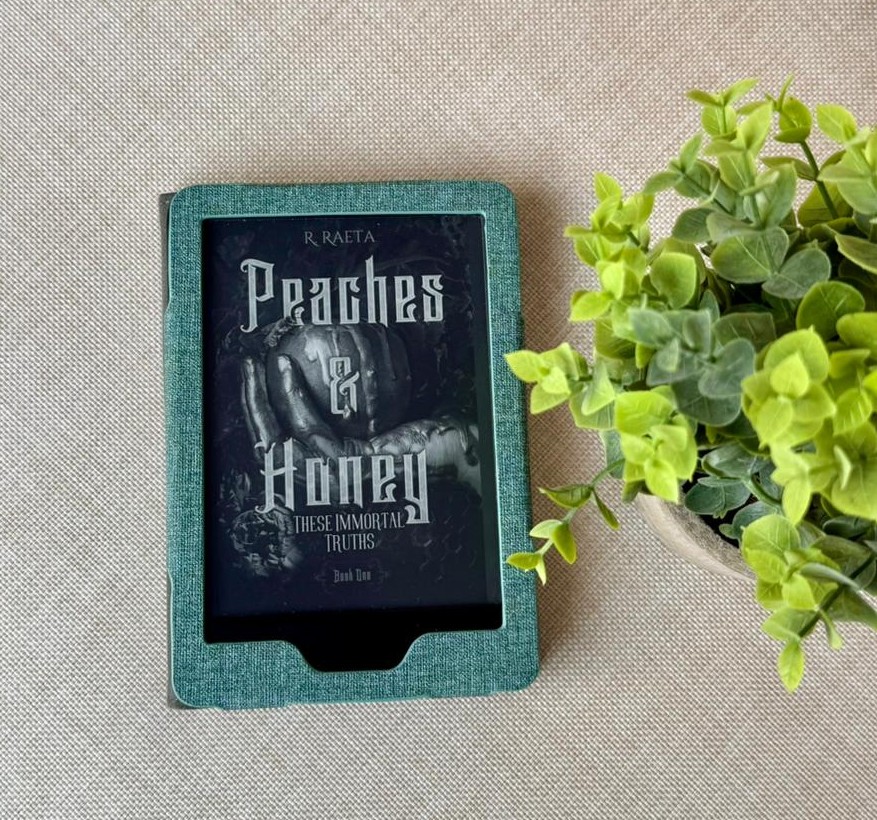
Peaches & Honey is that kind of book.
On paper, it sounds deceptively simple: immortality, time, a god, a woman, history unfolding in chapters instead of dates. But what it actually is… is a meditation on the world. On what survives it. On what doesn’t. On the unbearable tenderness of continuing to care anyway.
Anna and Khiran do not look at the world the same way — and somehow, that’s exactly why this story works.
Anna moves through centuries with a gentleness that feels almost defiant. She believes in healing, in kindness, in the possibility that small goodness matters even when history keeps proving otherwise. She notices beauty where it would be easier to go numb. She tastes apples. She listens to music through walls. She helps, even when helping costs her something. Even when helping costs her Everything. Sure, she can’t die… can she?
She takes in a dirty, abandoned boy near a French village. Loves him. Raises him. Becomes his mother in every way that matters. And she knows — from the very beginning — that this love has an expiration date. That immortality makes loss inevitable, not optional.
And yet — this book refuses the idea that love disappears just because time moves on.
Decades later, when Anna returns to the house where she raised Pier, she doesn’t find emptiness. She finds legacy. She finds his grandson. An old man who knows exactly who she is. Who has been told the stories all his life. Who has been waiting — because Pier believed that one day, his mother would come back. And when she did, she deserved to be welcomed.
That moment shattered me.
Because it proves something the book understands better than most stories about immortality ever do: love doesn’t need permanence to be real. It doesn’t need ownership. It doesn’t even need presence.
It survives in memory. In stories passed down. In the quiet act of leaving a light on for someone who might return centuries later.
And Khiran — Khiran has seen too much to be soft about it. But there’s also something quietly extraordinary about him— something the book spells out loudly, but also lets you grasp. He belongs everywhere. Not in the watered-down, misunderstood way myths often do, but in the way cultures try — and fail — to grasp something too old, too complex to pin down.
He is Lucifer. He is Loki. He is every rebellious god who refused blind obedience, every figure cast as a villain simply because he questioned the order of things. Civilizations name him differently, soften him, demonize him, reshape him — but the essence stays the same. A witness. A challenger. A reminder that morality is never as simple as stories want it to be.
He doesn’t romanticize history. He doesn’t dress suffering up as glory. When he looks at the world, he sees the blood beneath the stone, the bodies beneath the monuments, the wars retold as bedtime stories once enough time has passed. Glorified, stupid bedtime stories told to children who will grow eager to fight the way their forefathers fought, “only to realize the lie of it all to late”.
“It is hard for me to see beauty in many of man’s wonders,” he admits, voice haunted by memories. “I
was there when it was built. I saw the lives its foundation was built on. It only stands because a great many suffered. The same with so many of man’s marvels-the pyramids in Egypt, the Great Wall in China, the Colosseum in Rome.”
He shakes his head. “You see a marvel, but I still see the blood those stones were baptized in.“
A marvel and a grave. That line alone carries more truth than entire history textbooks.
Khiran isn’t cruel. He’s honest. Brutally so — but never empty. His perspective isn’t about pessimism; it’s about memory. About refusing to let the world forget what it costs to become what it calls “great.” And Anna doesn’t argue with him. She doesn’t deny it. And that — that quiet, devastating balance — is the soul of this duology.
Because this story never asks you to choose between hope and realism. It lets them exist side by side. It lets love exist in a world that keeps breaking itself. It lets immortality feel exactly like what it would be: not a gift, not a curse — just endurance.
Anna heals people knowing she will outlive them.
Khiran watches civilizations rise and rot and rename their gods.
And still — still — they choose to care.
Immortality here isn’t about spectacle. It’s about accumulation. Of memories. Of grief. Of quiet mornings and unbearable nights. Of loving someone who will always return — and always leave — until time itself stops making sense.
And the writing — God, the writing.
It’s lyrical without being precious. Philosophical without being heavy-handed. Every quote feels earned, like it has lived a few centuries before reaching the page. War isn’t stylized. Progress isn’t celebrated blindly. Even medicine advancing comes with the bitter realization that weapons evolve just as fast.
“Medicine has advanced, progressing forward in leaps and bounds…
It would be all the more wonderful, if only the weapons of war hadn’t evolved too.”
This book understands cycles. How they repeat. How they’re renamed. How every generation believes it’s different — until it isn’t.
And the cycle continues.
And continues.
And yet — despite all of this — the story is never cold.
Because at its core, this is still a love story. Not loud. Not rushed. A slow burn stretched across centuries. A devotion that survives distance, time, separation, and the unbearable weight of knowing too much about the world.
“Loving her is the closest I will ever come to enlightenment.” I don’t know how you read that and come out unchanged.
Peaches & Honey didn’t just make me think about time. They made me think about how I want to move through it.
With Anna’s kindness — even when it hurts.
With Khiran’s honesty — even when it’s uncomfortable.
With eyes open. With memory intact. With love that doesn’t pretend the world is good, but chooses to care anyway.
This is a story I will carry with me for a very long time.
Possibly forever.
*This is a duology – but the second book, Pits & Poison: These Godly Lies deserves its own space.