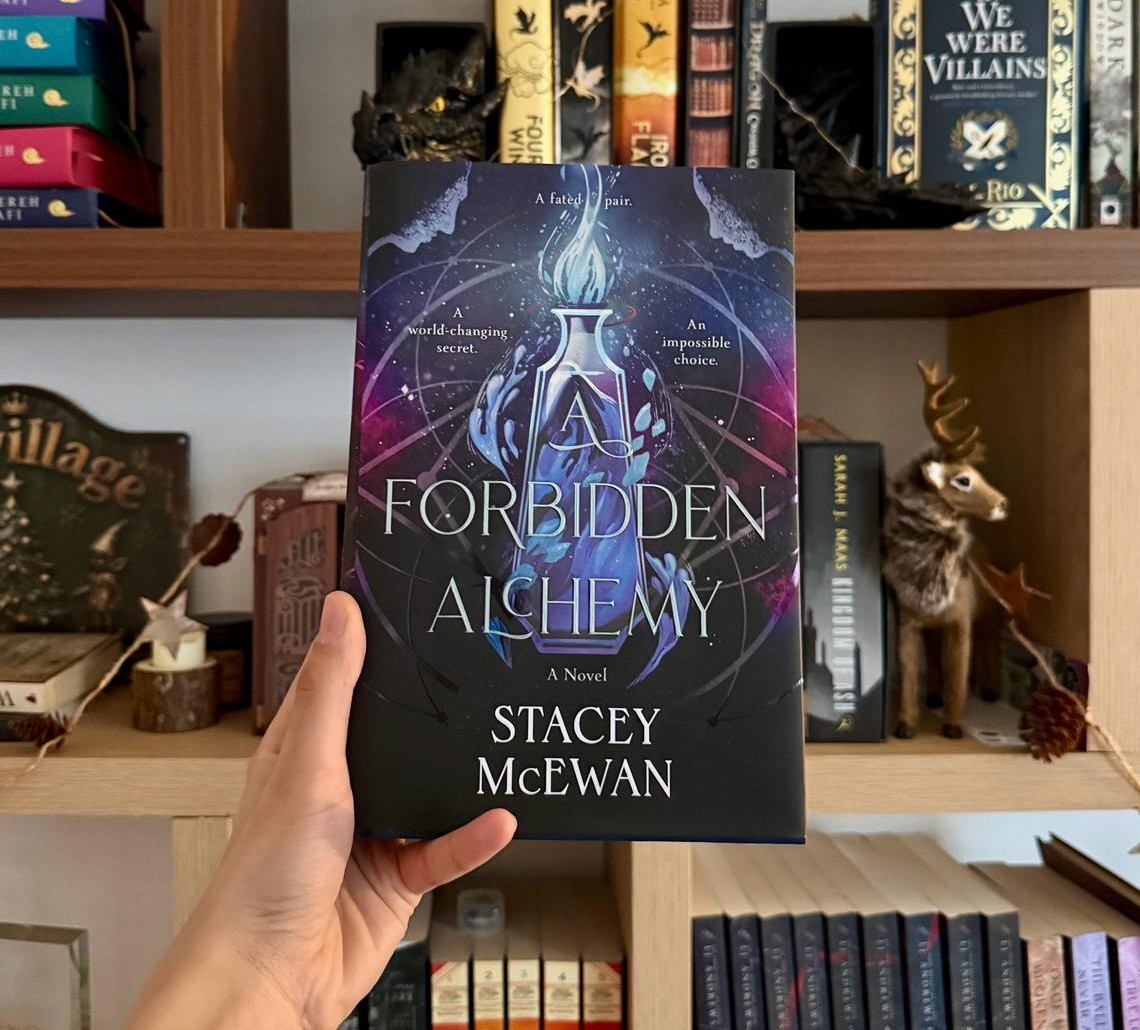
I went into A Forbidden Alchemy the way I go into most romantasy lately: mildly suspicious, emotionally available, fully prepared to side-eye the hype. You know the drill. Gorgeous cover. Big promises. My brain already whispering don’t get attached.
Mind me, I got attached.
Not in the dramatic, scream-into-the-void way.
More like the slow realization that something sharp is happening under the romance. That this isn’t just about magic and longing and men with brooding energy (though yes, those are very much present). It’s about who gets chosen, who gets used, and who is expected to carry the cost quietly.
Which is rude, frankly. I was here for escapism, not political ideologies cloaked in magic vials.
At its surface, A Forbidden Alchemy looks pretty simple: two children from mining towns, one big city that decides who matters, magic distributed like a birthright lottery. Except it’s not a lottery. It’s curated. Controlled. And sold as destiny.
Artisans aren’t born. They’re chosen.
That line alone tells you everything. Because being chosen sounds romantic until you realize it always requires someone else to be left behind.
What I loved—and yes, loved, I’m committing—is how the book never lets romance soften that truth. Love doesn’t save the system. It doesn’t excuse it. If anything, it makes the injustice louder. Sharper. Harder to ignore. Nina and Patrick aren’t star-crossed for the aesthetic of it. They’re pulled apart by a machine that thrives on separation. On class. On labor. On telling some people their bodies exist to fuel the world, while others get to reshape it.
And somehow, in the middle of all that, the book still manages yearning.
Proper yearning. The kind that doesn’t shout, but lingers. The kind that looks at you sideways and says, I remember you, even after years of silence and opposite sides of a war. The kind that doesn’t play games. Patrick, especially, is painfully direct in a way that feels almost radical. No posturing. No manipulation. Just intent.
There’s two lines— those lines you underline not because it’s poetic, but because it tells you who a character is:
“What does that mean?”(justice) “Sometimes it means feedin’ people, helpin’ them find safety.
Other times, it means dynamite and bad deals and men with bullets between their eyes.”
“He’s bad to those who’re bad. No idea if that makes him good, though.”
And it doesn’t, in my opinion, it doesn’t make him good. My view on this matter is simple and I’m gonna use no other than Batman to define it: if you kill a killer, the number of killers in the world remains the same. Okay, fine, it’s probably (surely) more nuanced than that, but who am I to go against Batman now?
Anyway, let’s go back to A Forbidden Alchemy. Yes, romantasy, but make it political.
What surprised me most wasn’t the magic system (although it’s original, I’ll give Stacey credit for that ). It was how un-glamorous the world feels. Mining towns with calloused hands. Families that love fiercely but are trapped by necessity. A city that shines because it feeds on the unseen.
There’s no neat moral packaging here. Just gray choices, inherited violence, and people trying to love without becoming complicit.
But beyond the crushes and the banter (which is genuinely fun, not Marvel-quippy, bless), what stayed with me was the tension between choice and loyalty. Between survival and resistance. Between loving someone and betraying the world that shaped you.
This book doesn’t ask who do you love?
It asks what are you willing to uphold because you love them?
And that’s a far more uncomfortable question.
By the end, I wasn’t thinking about twists or reveals. I was thinking about how easy it is to mistake comfort for morality. How often power hides behind ceremony. How romance doesn’t redeem systems—it exposes them.
Which is probably why the ending works. It doesn’t soothe. It sharpens.
WHO AM I KIDDING? It crushes.
A Forbidden Alchemy didn’t cup my face and tell me everything would be fine.
It leaned in and said: pay attention. And then it crumbled down. Buried us alive. Pun intended.
Rude. Beautiful. I’ll absolutely be back for book two.